[ivory-search id="3327" title="AJAX Search Form"]


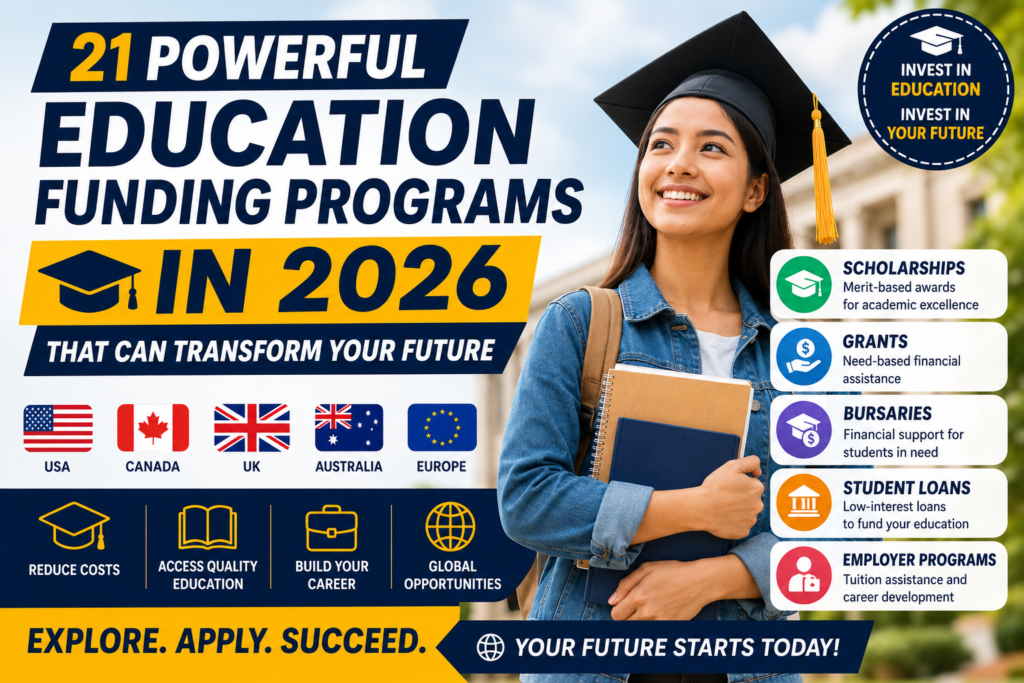
Education Funding Programs in 2026 That Can Transform Your Future
The cost of education continues to rise across the world, making financial support more important than ever. Fortunately, education funding programs in 2026 are helping millions of students access quality education without carrying overwhelming financial burdens.
Whether you are a high school graduate planning to attend university, a college student seeking additional funding, a postgraduate researcher, or an adult learner returning to school, there are numerous education funding programs available to help cover tuition, accommodation, books, and living expenses.
Countries such as the United States, Canada, the United Kingdom, Australia, and South Africa continue to expand educational support initiatives aimed at making learning more accessible.
This comprehensive guide explores the best education funding programs in 2026, how they work, eligibility requirements, and how students can maximize their chances of receiving funding.
What Are Education Funding Programs?
Education funding programs are financial assistance initiatives designed to help students pay for educational expenses.
Funding may come from:
- Governments
- Universities
- Private organizations
- Non-profit foundations
- Corporations
- International organizations
These programs often cover:
- Tuition fees
- Accommodation
- Textbooks
- Living expenses
- Research costs
- Travel expenses
- Technology requirements
The primary goal is to remove financial barriers and improve access to education.
Why Education Funding Matters in 2026
According to data from the UNESCO Institute for Statistics and the Organisation for Economic Co-operation and Development (OECD), higher education participation continues to grow globally.
However, rising tuition costs remain one of the biggest obstacles facing students.
Education funding programs in 2026 help address:
- Student debt
- Educational inequality
- Skills shortages
- Workforce development
- Economic growth
Governments and employers increasingly recognize that investing in education benefits both individuals and economies.
Types of Education Funding Programs in 2026
Understanding the different types of funding can help students identify opportunities that match their needs.
1. Scholarships
Scholarships are typically awarded based on:
- Academic excellence
- Leadership achievements
- Athletic performance
- Community involvement
- Talent and creativity
Unlike loans, scholarships do not require repayment.
Examples include:
- Merit scholarships
- Athletic scholarships
- Leadership scholarships
- STEM scholarships
- Diversity scholarships
2. Grants
Grants are usually awarded based on financial need.
Government grants remain one of the most popular forms of student assistance.
Common grant providers include:
- Federal governments
- Provincial governments
- State governments
- Educational institutions
Most grants do not need to be repaid.
3. Bursaries
Bursaries are widely used in countries such as South Africa and Canada.
These funding programs focus primarily on financial need.
Bursaries may cover:
- Full tuition
- Partial tuition
- Accommodation
- Learning materials
4. Student Loans
Student loans remain an important funding option for many students.
Unlike grants and scholarships, loans must be repaid.
Common providers include:
- Government agencies
- Commercial banks
- Educational finance organizations
Students should always understand repayment terms before accepting loans.
5. Employer-Sponsored Education Programs
Many employers now fund employee education.
Benefits may include:
- Tuition reimbursement
- Professional certification support
- Skills development funding
- Graduate education assistance
These programs are particularly popular in technology, healthcare, and finance sectors.
Top Education Funding Programs in the United States
The United States offers some of the world’s largest education funding initiatives.
Federal Pell Grant
The Federal Pell Grant assists undergraduate students with demonstrated financial need.
Benefits include:
- No repayment required
- Available nationwide
- Supports millions of students annually
Official Website:
https://studentaid.gov
Federal Student Aid (FSA)
Federal Student Aid provides:
- Grants
- Loans
- Work-study programs
Students apply through the FAFSA process.
Official Website:
https://studentaid.gov
Fulbright Program
The Fulbright Program supports international educational exchange.
Funding includes:
- Tuition
- Travel
- Research support
- Living expenses
Official Website:
https://fulbrightprogram.org
Top Education Funding Programs in Canada
Canada offers excellent student funding opportunities.
Canada Student Grants
Eligible students may receive:
- Tuition assistance
- Living expense support
- Accessibility grants
Official Website:
https://www.canada.ca
Vanier Canada Graduate Scholarships
One of Canada’s most prestigious graduate funding programs.
Supports doctoral students with significant research potential.
Official Website:
https://vanier.gc.ca
Top Education Funding Programs in the United Kingdom
The UK remains a leading destination for international education.
Chevening Scholarships
Funded by the UK Government.
Benefits include:
- Full tuition
- Accommodation support
- Travel costs
- Networking opportunities
Official Website:
https://www.chevening.org
Commonwealth Scholarships
Designed for students from Commonwealth countries.
Covers:
- Tuition
- Flights
- Living expenses
Official Website:
https://cscuk.fcdo.gov.uk
Top Global Education Funding Programs
Erasmus+
One of the world’s largest education mobility programs.
Supports:
- Student exchanges
- Study abroad opportunities
- Research collaboration
Official Website:
https://erasmus-plus.ec.europa.eu
Mastercard Foundation Scholars Program
Supports talented students from economically disadvantaged backgrounds.
Benefits often include:
- Tuition
- Accommodation
- Leadership development
- Career support
Official Website:
https://mastercardfdn.org
Education Funding Programs for STEM Students
STEM fields continue to receive significant funding.
Popular areas include:
- Artificial Intelligence
- Data Science
- Engineering
- Cybersecurity
- Renewable Energy
- Biotechnology
Governments increasingly prioritize STEM funding due to global skills shortages.
Education Funding Programs for International Students
International students can access funding through:
- University scholarships
- Government-sponsored programs
- Research grants
- International foundations
Many universities reserve substantial funding specifically for international applicants.
How to Qualify for Education Funding Programs
Eligibility varies by program.
Common requirements include:
Academic Performance
Strong grades improve funding opportunities.
Financial Need
Many programs prioritize students from lower-income households.
Leadership Activities
Leadership experience strengthens applications.
Community Involvement
Volunteer work demonstrates commitment and initiative.
Personal Statements
Well-written essays can significantly improve selection chances.
How to Find Education Funding Programs in 2026
Students should explore:
Government Websites
Government portals often provide comprehensive funding information.
University Financial Aid Offices
Most universities maintain scholarship databases.
Corporate Scholarship Programs
Large companies increasingly invest in student development.
Non-Profit Organizations
Many charitable foundations provide educational funding.
Professional Associations
Industry organizations frequently offer student support.
Common Mistakes Applicants Make
Avoid these mistakes:
- Missing deadlines
- Submitting incomplete applications
- Ignoring eligibility requirements
- Using generic essays
- Failing to provide supporting documents
Preparation and attention to detail are critical.
Future Trends in Education Funding
Several trends are shaping education funding programs in 2026.
AI-Powered Scholarship Matching
Technology helps students discover suitable opportunities.
Skills-Based Funding
More programs focus on workforce development needs.
Online Learning Support
Funding increasingly covers digital education pathways.
Green Skills Scholarships
Sustainability-related programs continue to expand.
Diversity and Inclusion Funding
Organizations are investing more heavily in equitable access to education.
Frequently Asked Questions (FAQ)
What are education funding programs?
Education funding programs provide financial assistance to help students pay for tuition, accommodation, books, and other educational expenses.
Do scholarships need to be repaid?
No. Scholarships are generally awarded as financial support that does not require repayment.
What is the difference between a grant and a scholarship?
Scholarships are often merit-based, while grants are usually awarded based on financial need.
Can international students apply for education funding?
Yes. Many universities, governments, and organizations offer funding specifically for international students.
Which countries offer the best education funding programs?
The United States, Canada, the United Kingdom, Australia, Germany, and several European countries offer extensive funding opportunities.
How can I improve my chances of receiving funding?
Maintain strong academic performance, participate in leadership activities, volunteer in your community, and submit high-quality applications before deadlines.
Are there education funding programs for online courses?
Yes. Many organizations now support online learning, professional certifications, and digital skills training.
Final Thoughts
Education funding programs in 2026 continue to open doors for millions of students around the world. From scholarships and grants to bursaries and employer-sponsored learning initiatives, there are more opportunities than ever to finance your education and achieve your academic goals.
The key to success is starting early, researching thoroughly, and applying to multiple funding opportunities. Whether you are studying in the United States, Canada, the United Kingdom, or elsewhere, education funding programs can significantly reduce financial barriers and help you focus on what matters most—your future.
By taking advantage of available scholarships, grants, bursaries, and student aid programs, students can gain access to world-class education while minimizing financial stress and maximizing career opportunities.
Recommended Internal Links
- Learnership Programmes 2026
- Internship Opportunities 2026
- Graduate Programmes 2026
- Bursaries Open for Application
- NSFAS Application Guide
Recommended External Sources
- UNESCO: https://www.unesco.org
- OECD Education Statistics: https://www.oecd.org/education
- Federal Student Aid: https://studentaid.gov
- Chevening Scholarships: https://www.chevening.org
- Erasmus+: https://erasmus-plus.ec.europa.eu